
First “Sunday Question” (Sonndesfro) after the 2023 general election
21.10.2024
Why the “Sunday Question”?
Originating in opinion and election research in Germany and Austria, the Sunday question (also known as the voting intentions question) refers to the question on current voting intentions. This question has established itself as a standard empirical research instrument and is used by academic and private polling organizations. In Luxembourg, ILRES regularly conducts the “Sonndesfro” on behalf of Luxemburger Wort and RTL. The anonymous raw data were analyzed by Kantar Public Germany. The calculation model takes into account various variables such as age, gender and partisan identification of voters, as well as panachage. For the first political climate barometer after the 2023 national elections, voters were asked which party they would vote for if the elections were held next Sunday. A total of 1,872 eligible voters were surveyed between September 23 and 30. The survey was carried out by landline telephone (297 people), cell phone (850 people) and online (725).
© Luxemburger wort, RTL
Pirates walk the plank
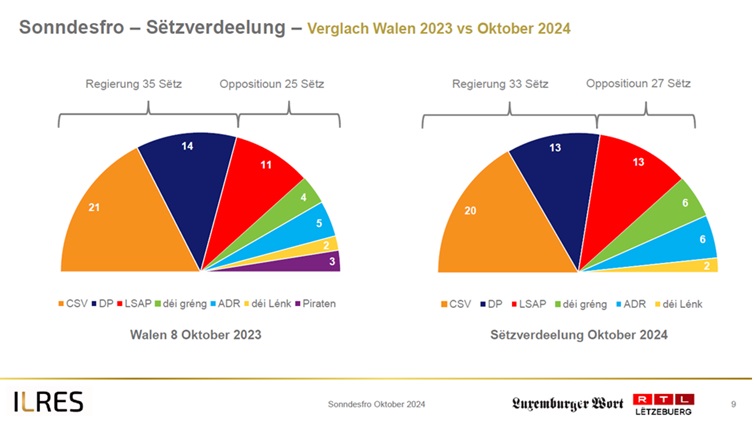
Their defeat came as no great surprise after the relentless waves of negative publicity. If voters were to go to the polls next Sunday, the Pirate party would have no seats at all in the Chamber of Deputies. In fact, it has already lost one of the three seats it won in the last election. If it were up to our respondents, they’d lose the remaining two seats too. A harsh message. Even in terms of percentages, the party has the worst score measured in our polls since 2018. Compared with the results of the October 2023 elections, the governing coalition, the CSV and the DP, would each lose a seat too. Perhaps a sign that voters’ expectations have not yet been met?
21.10.2024
Why the “Sunday Question”?
Originating in opinion and election research in Germany and Austria, the Sunday question (also known as the voting intentions question) refers to the question on current voting intentions. This question has established itself as a standard empirical research instrument and is used by academic and private polling organizations. In Luxembourg, ILRES regularly conducts the “Sonndesfro” on behalf of Luxemburger Wort and RTL. The anonymous raw data were analyzed by Kantar Public Germany. The calculation model takes into account various variables such as age, gender and partisan identification of voters, as well as panachage. For the first political climate barometer after the 2023 national elections, voters were asked which party they would vote for if the elections were held next Sunday. A total of 1,872 eligible voters were surveyed between September 23 and 30. The survey was carried out by landline telephone (297 people), cell phone (850 people) and online (725).
© Luxemburger wort, RTL
Pirates walk the plank
Their defeat came as no great surprise after the relentless waves of negative publicity. If voters were to go to the polls next Sunday, the Pirate party would have no seats at all in the Chamber of Deputies. In fact, it has already lost one of the three seats it won in the last election. If it were up to our respondents, they’d lose the remaining two seats too. A harsh message. Even in terms of percentages, the party has the worst score measured in our polls since 2018. Compared with the results of the October 2023 elections, the governing coalition, the CSV and the DP, would each lose a seat too. Perhaps a sign that voters’ expectations have not yet been met?
Stronger opposition
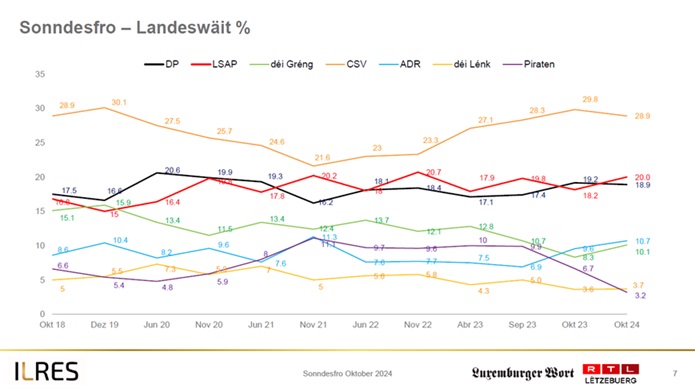
The LSAP and the Greens would each obtain two seats, the ADR one. The opposition emerges stronger, despite the loss of the Pirates. However, if we look at the trend over the years, we see that the Socialists are stable and the Greens are still relatively weak. The evolution of ADR remains to be seen.
© Luxemburger wort, RTL
To find out what voters think about the controversial ban on begging or topics such as the pension system or climate change, you can consult the publications of RTL and theLuxemburger Wort respectively:
CONTACTS ILRES
